
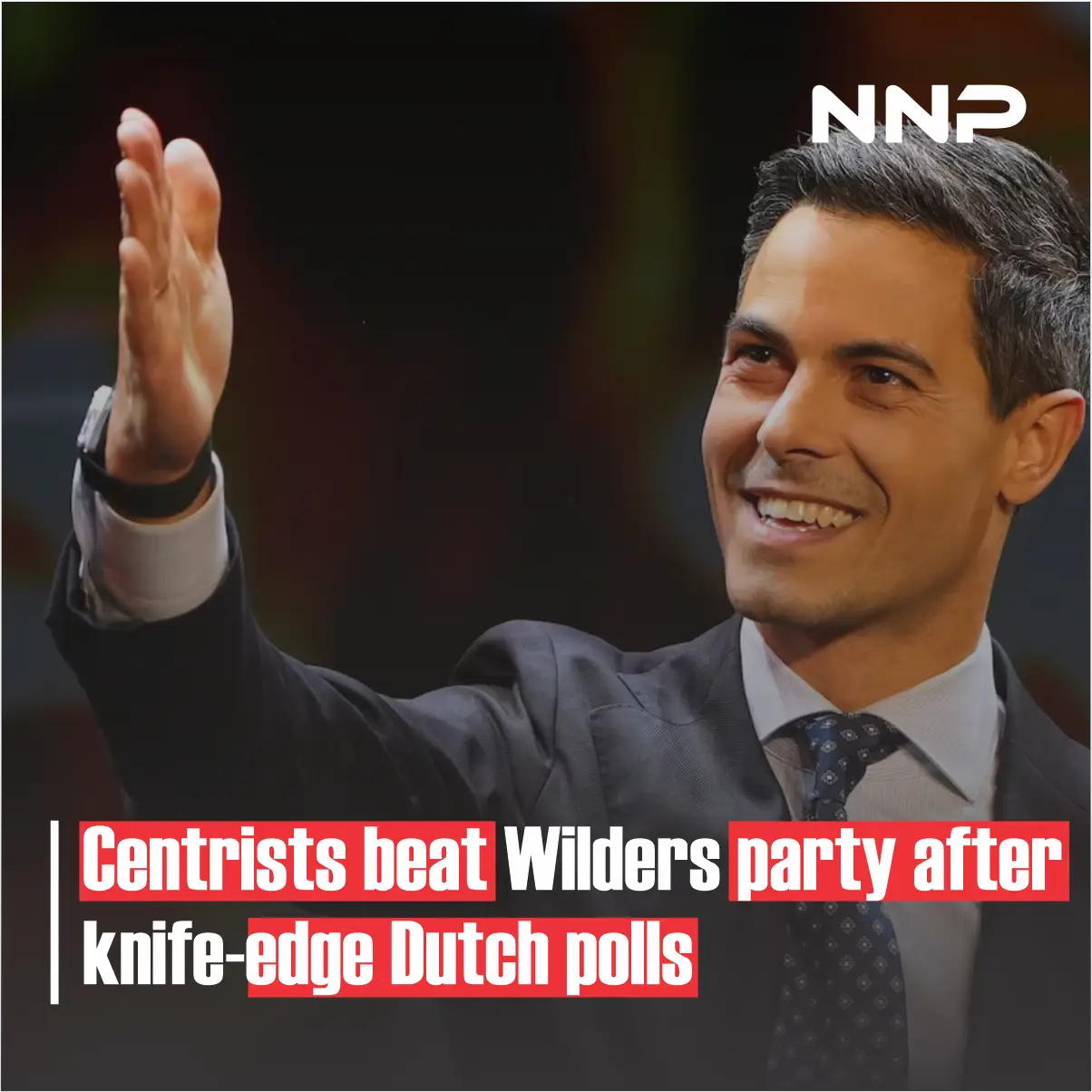
Amsterdam — In a dramatic turn of events on Wednesday, the Dutch electorate appears to have decisively rebuffed the rise of the far right, handing a narrow but symbolically significant victory to the centrist-liberal party Democrats 66 (D66) led by Rob Jetten.
With nearly all votes counted, the independent Dutch news agency ANP projected that D66 can no longer be overtaken by the far-right Party for Freedom (PVV) of Geert Wilders. The margin is razor-thin — D66 holds a lead of about 15,000 votes, equating to a projected seat count of 26 or possibly 27 in the 150-seat lower house, versus 26 seats for the PVV.
The significance of the result
The outcome sends a strong message: mainstream Dutch voters appear to have grown impatient with political disruption and radical populist rhetoric. Jetten hailed the result as evidence that “populist movements can be beaten” with a message of optimism and cooperation.
For Wilders and the PVV, the loss — after being the dominant force in the 2023 election — is dramatic and disheartening. The party’s seat count has fallen significantly and all major parties are reported to have ruled out forming a government with Fishers’s far-right team.
What swung the vote
A number of factors help explain D66’s surge and the PVV’s stumble:
- D66 ran a campaign emphasising housing, climate, integration and a pro-European stance, giving it broad appeal beyond its traditional liberal base.
- The collapse earlier this year of a PVV-led coalition — which brought political instability and uproar over asylum policy — left many voters looking for more steady hands.
- While the PVV remains a major force, some of its voters appear to have shifted to smaller right-wing parties instead of staying with Wilders.
The path ahead: Coalition politics
Despite topping the polls, D66 is still far from having a majority. With only about 17 – 18 % of the vote and 26–27 seats, Jetten must build a coalition network reaching 76 seats in the 150-member house.
Possible partners include the centre-right People’s Party for Freedom and Democracy (VVD), the Christian-Democrat Christian Democratic Appeal (CDA) and the left-leaning GroenLinks‑PvdA bloc. However, ideological distances and past tensions may complicate negotiations. Coalition talks could take weeks or even months.
Meanwhile, Wilders has signalled his readiness to challenge the result and pointed to alleged irregularities in postal voting — though no evidence has been publicly substantiated.
Broader implications for Europe
This Dutch election will draw attention across the continent. At a time when far-right populist parties have made gains elsewhere in Europe, this result offers a counter-narrative: that electorates are not irrevocably destined to slide toward hard-line nationalism. Jetten himself said the victory shows “it is possible to beat populist movements” when you campaign on a forward-looking vision.
Still, the narrow margin underlines that the far right remains a potent political force — indeed, a sizable section of the electorate rejected both the radical option and the traditional mainstream. With fragmentation deepening, stable governance is not guaranteed.
What to watch next
- Coalition formation: Which parties will join D66, and which policy compromises will be made? The outcome will determine how the Netherlands addresses urgent issues like housing, migration, climate, and economic growth.
- Wilders’ next move: While seemingly sidelined, Wilders remains influential; his ability to influence or disrupt from opposition could matter.
- Policy direction: A D66-led government would likely be more pro-European, socially liberal and focused on innovation, contrasting sharply with the aggressive anti-immigration agenda of PVV.
- Impacts beyond the Netherlands: Observers will be closely watching whether this result signals a plateau for the far right in Europe or simply a temporary setback.