
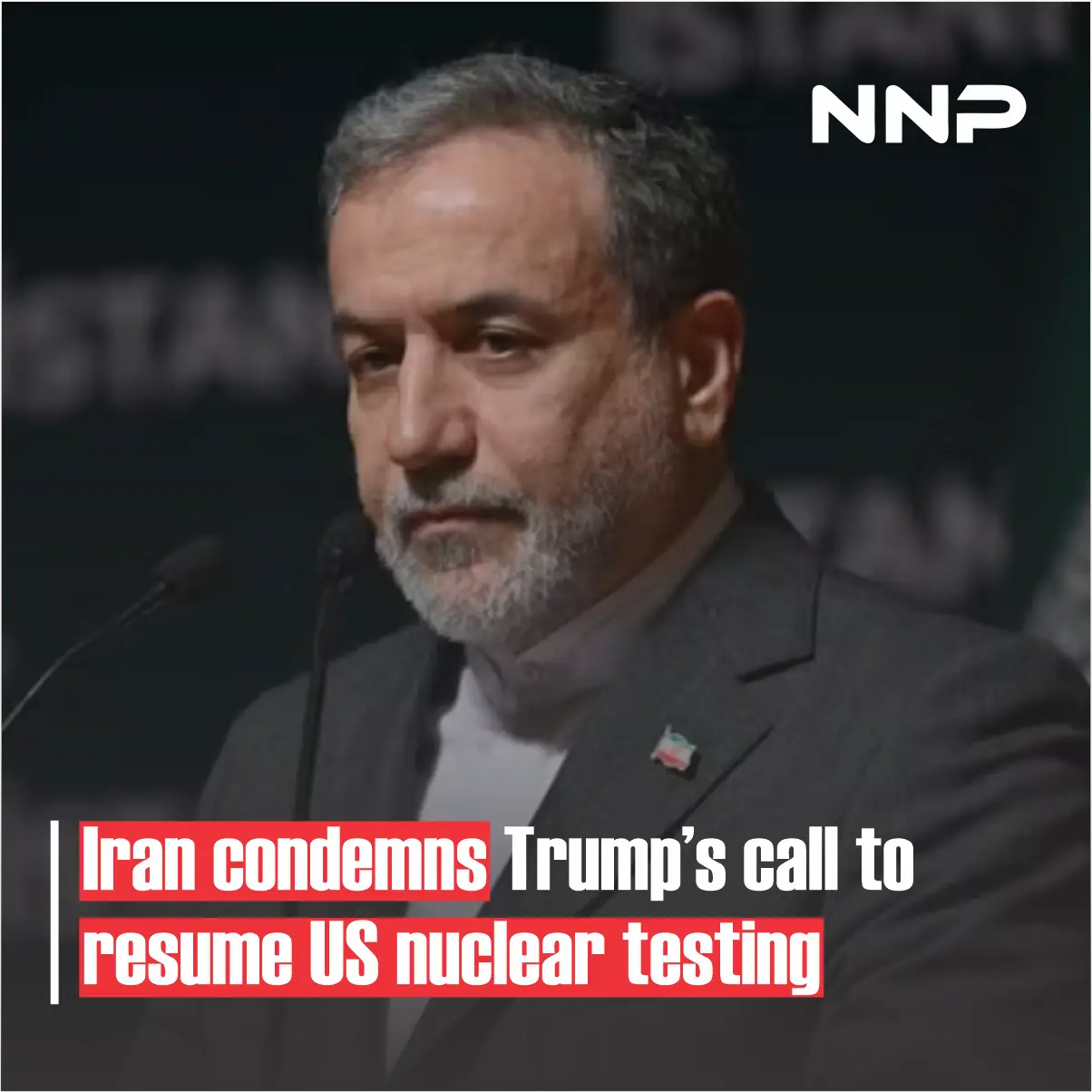
The Donald Trump administration’s decision to restart nuclear weapons testing has provoked a sharp backlash from Tehran. On 30 October 2025, President Trump directed the United States Department of Defense to begin a resumption of nuclear-weapons testing, citing a need to “match” the nuclear developments of Russia and China.
In response, Iran’s Foreign Minister Abbas Araghchi denounced the move as “regressive and irresponsible” and a direct threat to global peace and security.Araghchi accused the U.S. of hypocrisy: “A nuclear-armed bully is resuming testing of atomic weapons. The same bully has been demonising Iran’s peaceful nuclear programme,” he wrote in a social-media post.
What Iran is saying
- Iran frames the U.S. decision as deeply destabilising: “The announcement of a resumption of nuclear tests is a regressive and irresponsible move and a serious threat to international peace and security.”
- The Iranian leadership accuses the U.S. of double standards: condemning Iran’s nuclear activities while reviving its own nuclear-weapons testing.
- Iran warns this may normalise nuclear-weapons testing and foment a renewed arms race.
Why this matters
- The U.S. has not conducted an explosive nuclear test since 1992, and the global norm against nuclear-explosive testing has held for decades through treaties such as the Comprehensive Nuclear‑Test‑Ban Treaty (although the U.S. never ratified it).
- Iran’s response is shaped by the direct contrast: Tehran insists its nuclear programme is peaceful and within the framework of the International Atomic Energy Agency (IAEA) and the Nuclear Non‑Proliferation Treaty (NPT) — a point Iran has reiterated in past statements.
- By condemning the U.S. move, Iran is signalling it sees the decision as not just a Washington-Moscow-Beijing issue, but one that directly affects its own sense of fairness and international standing.
Regional and global implications
- With Iran condemning the U.S. move so forcefully, there is a risk of broader geopolitical fallout: neighbouring states, regional powers and other nuclear-armed states may interpret U.S. testing resumption as eroding the nuclear taboo and feel justification for their own escalations. Iran’s comments echo this concern. Al Jazeera+1
- Iran’s reaction may constrain diplomatic manoeuvres: for example, talks between Iran and the U.S. (or mediated by Europe) on nuclear or sanctions issues may become harder if Iran feels further aggrieved by U.S. policy.
- For non-proliferation frameworks, the U.S.’s step may undermine treaty norms and embolden other states that perceive the nuclear-weapons “club” acting without restraint.
What to watch next
- Whether the U.S. acts to carry out an actual explosive nuclear test, or whether the announcement is more symbolic or procedural (e.g., resuming subcritical tests or other experiments). Experts warn full testing could cost years and erode strategic stability.
- How Iran will respond politically: will it lodge formal complaints at the IAEA or the United Nations Security Council, or shift its posture in regional diplomacy or its own nuclear programme?
- Reactions from other major powers: Russia and China have already voiced concern — Russia warned US testing would lead to chaos.
- Impact on Iran-U.S. diplomatic channels: Iran could condition future engagement on restraint from the U.S. in nuclear and military matters.
In sum, Iran’s condemnation reflects a broader unease: the U.S.’s decision to resume nuclear-weapons testing cuts across existing arms-control norms, undermines Iran’s narrative of peaceful nuclear rights, and raises the stakes for regional and global nuclear stability. The coming weeks will show whether this becomes a turning point or a rhetorical flare-up.
Would you like me to pull in expert commentary on how this might affect the Middle East specifically, or look at what the next-day reactions from other regional players (like Saudi Arabia, UAE, Israel) are?