
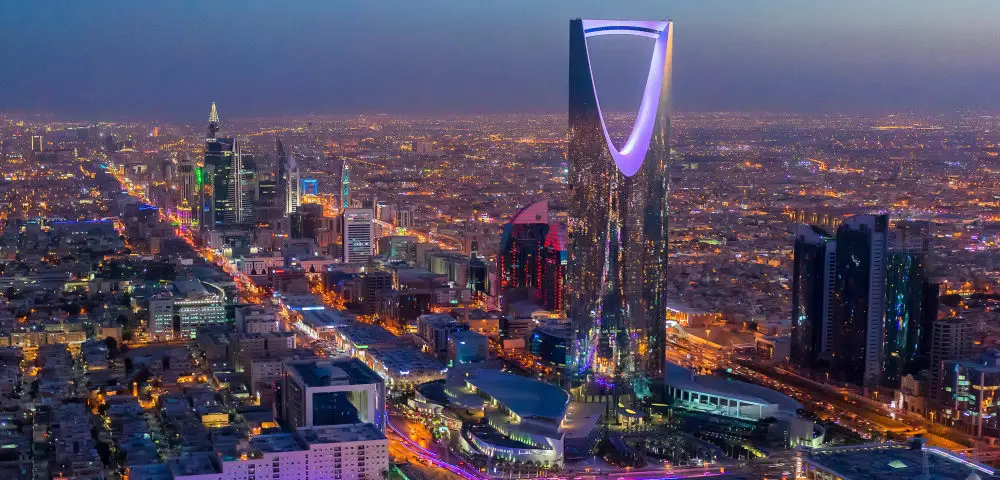
In recent months, the Kingdom of Saudi Arabia (KSA) has played host to an influx of global business leaders, investors and technology executives as the country surges ahead with its landmark giga-projects and artificial intelligence (AI) ambitions. With contract awards rising sharply and a robust push to shift from planning into execution, the Kingdom is positioning itself as a major node in the global business and innovation network.
Giga-Projects: From Vision to Execution
Under the banner of Saudi Vision 2030, KSA has committed to transforming its economy away from petroleum dependence and toward new sectors including tourism, tech, entertainment, sports, and urban development. A recent report by Knight Frank reveals that contract awards for Saudi “giga-projects” hit US$196 billion in 2025, up roughly 20 % compared with 2024. The National+2Knight Frank AE+2
Key regions powering this acceleration include Riyadh—where projects such as Diriyah Gate and the King Salman Park redevelopment are underway—as well as the western coast corridor anchored by NEOM, the Red Sea tourism initiative and others. Arab News PK+1
For example:
- At Diriyah, the total value of commissioned projects stands at US$14.5 billion, with another US$45.6 billion in the pipeline. Knight Frank AE+1
- The western region shows announced investments of US$431.3 billion since 2016, with US$57 billion already awarded and US$187.2 billion still in the pipeline. The National+1
What this means for visiting business leaders: the Kingdom is no longer sitting in planning mode—it’s actively awarding contracts, mobilising construction, recruiting global expertise and opening the door to international participation.
AI: The New Frontier
Parallel to the physical infrastructure push, Saudi Arabia is doubling down on digital infrastructure, especially AI. Industry studies show that in the construction sector alone, more than half of professionals identify AI as the most important trend shaping the industry. Al Arabiya English
In May 2025, Saudi Arabia announced the launch of HUMAIN, a new AI company owned by the Public Investment Fund (PIF) and chaired by Crown Prince Mohammed bin Salman. The company aims to develop advanced Arabic-language large language models, data-centre infrastructure and broader AI capabilities. Financial Times+1
For businesses in AI, analytics, software, automation and big-data, this signals a major opportunity: a nation seeking to build a home-grown AI ecosystem, attract global talent, and embed intelligent systems into industrial and infrastructure megaprojects.
Why the Business Elite Are Here
There are several compelling reasons why global business players are flocking to Saudi Arabia now:
- Massive Scale & Speed – The magnitude of investment (hundreds of billions of dollars) and the speed of contract awards make Saudi development exceptional in the global context.
- Diversity of Sectors – From real estate and hospitality to entertainment, gaming, AI and advanced manufacturing, the opportunities span multiple industries.
- Global-Local Partnerships – The Kingdom is actively courting international corporations, technology providers and investment funds to participate in its transformation agenda.
- First-mover Advantage – Early engagement may allow firms to secure favourable contracts, market access and strategic positions in untapped markets.
- Talent & Innovation Push – The AI agenda in particular opens doors for software, analytics, machine-learning, smart-city solutions and other high-value services.
Key Themes & Trends to Watch
- Urban & Entertainment Infrastructure – Projects like NEOM, Qiddiya and Diriyah are not just construction ones—they aim to become lifestyle, entertainment and innovation hubs. LinkedIn+1
- Smart Construction & Digital Tools – AI, BIM (Building Information Modelling), real-time scheduling and supply-chain optimisation are already being embedded in these giga-projects. Al Arabiya English
- AI Governance & Regulation – As Saudi builds its AI ecosystem, governance frameworks and ethical standards are increasingly on the agenda. arXiv
- International Trade & Tech Export Growth – For example, Pakistan’s IT export to Saudi Arabia is set to double amid Saudi’s $100 billion AI & data infrastructure investment. The Express Tribune
- Diversification & Non-Oil Economy Growth – Giga-projects and AI are central to diversifying the economy, increasing job creation, raising foreign investment and reducing oil-dependency. The National
Challenges & Considerations
While the opportunity is tremendous, some caveats remain for businesses considering participation:
- Execution Risk – Megaprojects on this scale come with logistical, regulatory and financial complexity. Timelines may slip.
- Talent & Capability Gaps – Although Saudi is investing in talent, building a full domestic ecosystem (especially for advanced AI) still takes time.
- Localisation Requirements – Some projects may require local content, partnerships or employment commitments which foreign firms must navigate.
- Competitive Landscape – Many firms are pursuing the same opportunities; standing out may require innovation, differentiation or specialised expertise.
- Regulatory & Governance Uncertainty – As AI regulation evolves, firms must be aware of data-protection, governance and ethical standards in KSA and the Gulf.
The Outlook — What to Expect Next
In the short term (2025–2026), expect more investment forums, public–private partnerships, AI ecosystem announcements and contract awards. Saudi Arabia’s business calendar is likely to feature major events, summits and exhibitions highlighting its development agenda.
Over the mid-term (towards 2030), the giga-projects and AI investments will begin to yield visible change: new cities, entertainment districts, smart-city infrastructure, data-centres, AI services and diversified economic clusters.
For any company with ambition in infrastructure, technology, AI, real estate or digital services, Saudi Arabia today offers a high-stakes, high-potential environment. The invitation is broad, but making the most of it may require strategic vision, local alignment and a readiness to move quickly.
Final Word
The Kingdom of Saudi Arabia is no longer simply talking about transformation—it is implementing it. With business leaders descending on Riyadh and other hubs, and with hundreds of billions in contracts being awarded, this moment presents a rare window for global companies to align with one of the most ambitious development programmes in the world. The convergence of giga-projects and AI makes this not just a construction boom, but a profound shift in how business, technology and geography are interacting in the 21st century Gulf.