
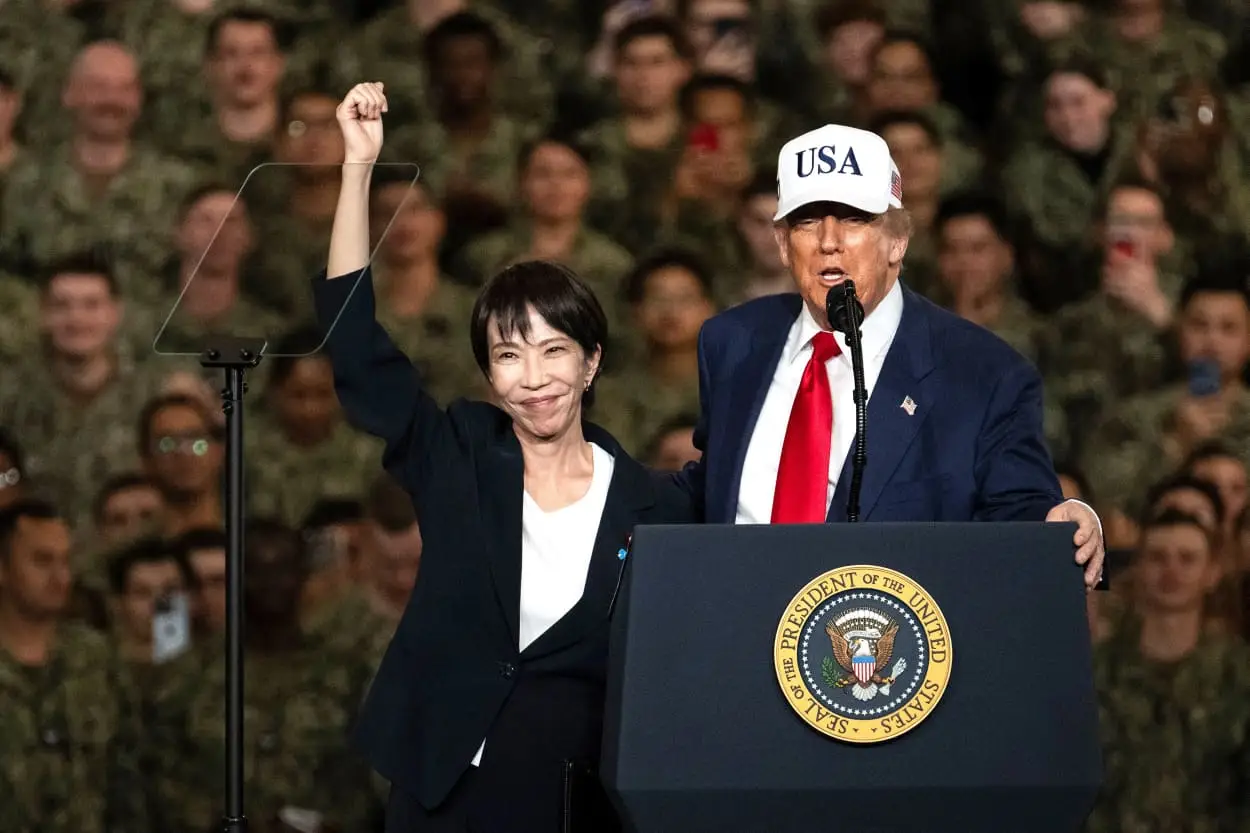
In a highly-publicised moment early on his Asia tour, President Donald Trump addressed U.S. service members aboard the USS George Washington, docked at the U.S. Navy’s Yokosuka base near Tokyo, Japan. The event underscored the intersection of defence, diplomacy and trade in the region.
Setting the Scene
On the deck of the carrier, flanked by servicemen and military hardware, President Trump delivered remarks not only praising the troops but also tying in the broader U.S.-Japan relationship—particularly trade and tariffs. His host that day was Japan’s newly elected Prime Minister Sanae Takaichi, the country’s first woman to hold the post, signifying a new phase in bilateral ties.
Praise for the Troops, Emphasis on Alliance
Trump lauded the American service members aboard the carrier, describing them as “the most remarkable relationship anywhere in the world” when referring to the U.S.-Japan alliance. He affirmed that the United States stands committed to Japan’s defence and that U.S. forces play a critical role in regional stability.
During his remarks, he also highlighted his respect for Prime Minister Takaichi, calling her appointment “a big deal” and saying of Japan: “We are an ally at the strongest level.”
Tariffs and Trade Enter the Mix
What made this talk different was the inclusion of trade and tariffs—areas typically separate from military-address speeches. Trump mentioned Japan’s investment commitments into the U.S. economy and tied trade performance to defence cooperation. Earlier this year he proposed linking U.S. troop cost-sharing with trade arrangements—a move that had already stirred tensions.
On this occasion, the administration announced that Japan had committed to a roughly US $550 billion investment framework in the U.S., paired with reciprocal tariffs and trade-deals that would open Japanese markets to more American-built vehicles and energy exports.
What’s Behind the Shift?
Why combine a military address with a trade talk? Analysts see this as part of the Trump administration’s “whole of alliance” approach—where defence, trade and economic investment are viewed as interconnected. By addressing service members and discussing tariffs in the same speech, Trump signalled that alliances are contingent not only on security cooperation but also on economic reciprocity.
For Japan, this came at a delicate moment. With Takaichi just in office, the country is recalibrating its security posture (including boosting defence spending) while managing economic pressures and trade expectations from its top ally.
Reactions & Implications
Military officials welcomed the support and spotlight on the carrier visit, viewing it as reaffirmation of U.S. commitment to the Pacific theatre. On the trade side, Japanese business and government leaders acknowledged the investment pledges, though cautioned that the details remain to be fully implemented.
This fusion of defence praise and trade talk also raises questions: Will other alliance forums follow this model? Will service members become routine audiences for trade-policy speeches? And how will Japan respond if economic demands grow alongside security expectations?
What’s Next?
As part of his Asia tour, President Trump is scheduled to continue to South Korea and meet with business and defence leaders there. The Japan visit sets the tone for deeper U.S.-Japan cooperation, but also signals tougher negotiating postures on trade and fairness.
For Japan, the coming weeks will be critical: implementing the investment commitments, deciding on defence spending increases, and balancing business interests with alliance expectations. For the U.S., the takeaway is clear: alliances are no longer just about bullets and bases – they’re about balance sheets and trade deals.